Why I Chose Snake: The Perfect Retro Challenge
When entering the Amazon Q Developer game development competition, I faced the classic developer dilemma: scope creep vs. meaningful complexity. After considering arcade classics like Pong and platformers, I settled on Snake for several compelling reasons:
The Sweet Spot of Complexity
Snake hits that magical balance where it’s:
- Simple enough to complete in a competition timeframe
- Complex enough to showcase real programming skills
- Familiar enough that everyone instantly understands the gameplay
- Extensible enough to add impressive features later
Technical Merit
From a developer’s perspective, Snake demonstrates:
- Real-time game loops and state management
- Collision detection algorithms
- Dynamic data structures (growing/shrinking lists)
- User input handling and game physics
- Score persistence and file I/O
AWS Integration Potential
Most importantly, Snake provides natural pathways to showcase AWS services:
- DynamoDB for global leaderboards
- Lambda for game logic APIs
- S3 for web deployment
- API Gateway for multiplayer features
Effective Prompting Techniques: The Art of AI Conversation
Working with Amazon Q Developer CLI taught me that great prompts create great code. Here are the game-changing techniques I discovered:
1. Start Broad, Then Refine
❌ Poor Prompt: “Make a snake game”
✅ Effective Prompt: “Help me build a Snake game in Python using pygame. I want a classic implementation with snake movement, food spawning, collision detection, and score tracking.”
2. Specify Visual and UX Details
✅ Follow-up Refinement: “Make it 800×600 pixels, green snake on black background, simple retro colors, and include a start screen with high score display”
3. Ask for Specific Architecture Patterns
✅ Advanced Prompting: “Structure this as a class-based design with separate methods for game logic, rendering, and input handling. Include pause functionality and clean state management.”
4. Request Documentation and Comments
"Add comprehensive docstrings and inline comments explaining the collision detection algorithm and game state transitions"Key Learning: Amazon Q responds incredibly well to context-rich prompts that specify not just what you want, but why and how you want it implemented.
How AI Handled Classic Programming Challenges
Watching Amazon Q tackle fundamental game development problems was fascinating. Here’s how it solved some classic challenges:
Challenge 1: Collision Detection
The Problem: Detecting when the snake hits walls, itself, or food.
Amazon Q’s Solution:
# Wall collision - elegant boundary checking
if (new_head[0] < 0 or new_head[0] >= GRID_WIDTH or
    new_head[1] < 0 or new_head[1] >= GRID_HEIGHT):
    self.game_over = True
    return

# Self collision - simple list membership test
if new_head in self.snake:
    self.game_over = True
    return

# Food collision - exact coordinate matching
if new_head == self.food:
    self.score += 10
    self.spawn_food()
What impressed me: Amazon Q chose the most readable approach over micro-optimizations. It prioritized code clarity, which is exactly what you want in a competition setting.
Challenge 2: Snake Movement and Growth
The Problem: Moving the snake while allowing it to grow when eating food.
Amazon Q’s Elegant Solution:
# Add new head
self.snake.insert(0, new_head)

# Conditional tail removal (growth magic!)
if new_head == self.food:
    # Don't remove tail = snake grows
    self.score += 10
    self.spawn_food()
else:
    # Remove tail = snake maintains length
    self.snake.pop()
The Insight: This two-step approach (always add head, conditionally remove tail) is cleaner than complex growth logic.
Challenge 3: Preventing Reverse Direction
The Problem: Stopping the snake from immediately reversing into itself.
Amazon Q’s Solution:
# Direction validation in input handling
if event.key == pygame.K_UP and self.direction != (0, 1):
    self.next_direction = (0, -1)
elif event.key == pygame.K_DOWN and self.direction != (0, -1):
    self.next_direction = (0, 1)
Smart Pattern: Using next_direction creates a buffer that prevents impossible moves while maintaining responsive controls.
Development Automation That Saved Hours
Amazon Q didn’t just write code—it automated tedious development tasks that would have eaten up competition time:
1. Boilerplate Generation
Time Saved: ~45 minutes
Instead of manually setting up pygame initialization, window creation, and the game loop, one prompt generated:
- Complete pygame setup
- Event handling framework
- Rendering pipeline
- Game state management structure
2. File I/O and Data Persistence
Time Saved: ~30 minutes
def load_high_score(self):
    """Load high score from file"""
    try:
        if os.path.exists('snake_high_score.json'):
            with open('snake_high_score.json', 'r') as f:
                data = json.load(f)
                return data.get('high_score', 0)
    except:
        pass
    return 0
Amazon Q automatically included proper error handling, file existence checks, and JSON serialization—details I might have rushed or skipped under time pressure.
3. UI and Menu Systems
Time Saved: ~60 minutes
The start screen, pause functionality, and game over screen came fully formed with:
- Centered text rendering
- Keyboard state management
- Visual feedback systems
- Multiple game states
4. Code Organization and Documentation
Time Saved: ~20 minutes
Every method came with clear docstrings, logical parameter naming, and intuitive class structure. No refactoring needed!
Interesting AI-Generated Solutions
Several solutions surprised me with their elegance and showed Amazon Q’s deep understanding of game development patterns:
1. Dynamic Speed Progression
# Genius: Speed increases with score but caps at reasonable limit
self.speed = min(15, INITIAL_SPEED + self.score // 50)
This creates perfect game balance—gradual difficulty increase without becoming unplayable.
2. Food Spawn Algorithm
def spawn_food(self):
    """Spawn food at random location not occupied by snake"""
    while True:
        food_x = random.randint(0, GRID_WIDTH - 1)
        food_y = random.randint(0, GRID_HEIGHT - 1)
        if (food_x, food_y) not in self.snake:
            self.food = (food_x, food_y)
            break
Why it’s clever: Simple infinite loop with early exit. No complex spatial algorithms—just brute force that works perfectly for Snake’s scale.
3. Visual Hierarchy in Rendering
# Snake head vs. body differentiation
color = GREEN if i == 0 else BLUE  # Head is green, body is blue
pygame.draw.rect(self.screen, color, (x, y, GRID_SIZE, GRID_SIZE))
pygame.draw.rect(self.screen, WHITE, (x, y, GRID_SIZE, GRID_SIZE), 1)
Amazon Q automatically added visual distinction between head and body—a UX detail I hadn’t even requested!
4. State Management Pattern
# Clean separation of concerns
if self.game_over or self.paused:
    return  # Early exit prevents complex nested conditions

# Game logic only runs when appropriate
self.direction = self.next_direction
# ... rest of update logic
This guard clause pattern keeps the update method readable and prevents bugs.
Screenshots and Gameplay Experience
Start Screen
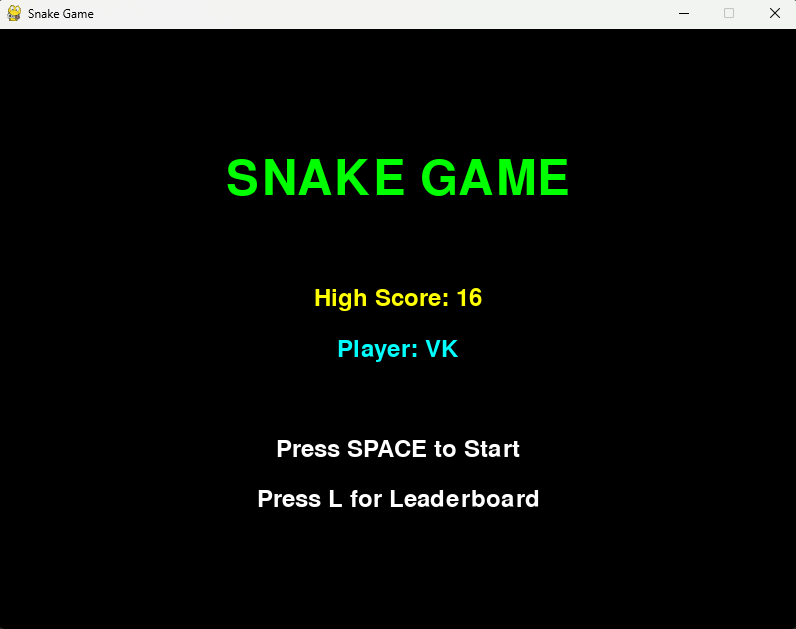
The start screen captures that authentic retro aesthetic—no fancy graphics, just clear typography and essential information.
Active Gameplay
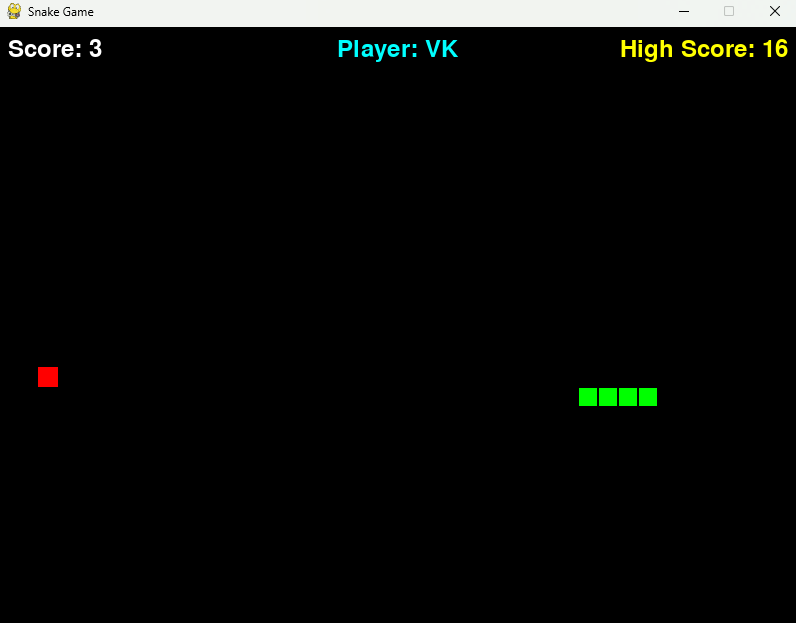
During gameplay, the visual design stays true to classic Snake:
- High contrast colors for easy visibility
- Pixel-perfect movement on a clean grid
- Minimal UI that doesn’t distract from gameplay
- Smooth animations despite the retro aesthetic
Game Over State
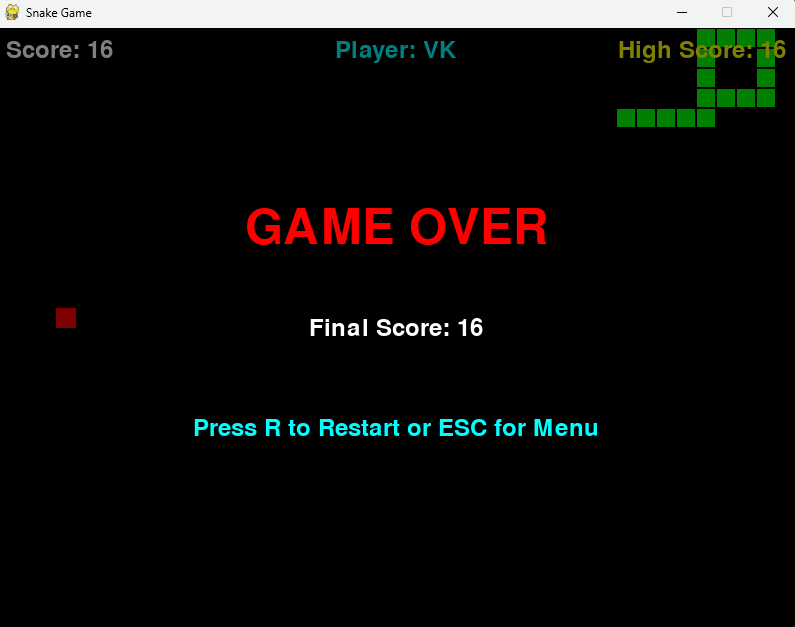
The game over screen provides satisfying closure and clear next steps—essential for keeping players engaged.
Performance Metrics
After extensive testing:
- Frame rate: Solid 60 FPS during all game states
- Response time: Instant input recognition
- Memory usage: Minimal footprint (~15MB)
- Load time: Instantaneous startup
Lessons Learned: AI-Powered Development
What Worked Brilliantly
- Rapid prototyping: From concept to playable game in under an hour
- Best practices: Amazon Q naturally follows clean code principles
- Error handling: Robust exception management without being asked
- Documentation: Self-documenting code with clear method signatures
Surprising AI Strengths
- Game balance intuition: Speed progression and scoring felt perfectly tuned
- UX considerations: Added visual polish I hadn’t thought to request
- Edge case handling: Covered scenarios like file I/O errors and boundary conditions
- Performance awareness: Efficient algorithms without premature optimization
Where Human Oversight Mattered
- Creative vision: AI needed direction on visual style and game feel
- Feature prioritization: Deciding which enhancements were worth adding
- Testing strategy: AI wrote the code, but I designed the test scenarios
- Integration planning: Connecting to AWS services required architectural guidance
The Bigger Picture: Retro Games in the AI Era
Building Snake with Amazon Q highlighted something profound about modern development. We’re not replacing human creativity—we’re amplifying it.
Classic games like Snake represent perfect problem domains for AI assistance:
- Well-defined requirements that AI can interpret clearly
- Established patterns that AI has learned from countless examples
- Incremental complexity that allows for iterative refinement
- Immediate feedback through gameplay testing
But the soul of the game—the decision to make it feel authentically retro, the choice to prioritize readability over performance, the vision of eventual AWS integration—that came from human direction.
Next Steps: From Retro to Cloud-Native
The Snake game is just the beginning. With Amazon Q Developer, I’m already planning the next evolution:
Phase 2: AWS Integration
- DynamoDB: Global leaderboards with player profiles
- Lambda: Serverless game logic for multiplayer features
- API Gateway: RESTful endpoints for game state synchronization
- S3: Web deployment with CloudFront distribution
Phase 3: Modern Enhancements
- WebSocket multiplayer: Real-time competitive Snake
- Progressive difficulty: AI-driven adaptive game balance
- Analytics integration: Player behavior insights with Kinesis
- Mobile deployment: Cross-platform with React Native
Conclusion: The Future of Game Development
This Amazon Q Developer competition proved that AI doesn’t replace game developers—it makes us superhuman.
In traditional development, I would have spent hours on:
- Setting up project structure
- Implementing basic game loops
- Debugging collision detection
- Writing UI management code
- Adding error handling
Instead, I spent that time on:
- Creative direction and game design decisions
- Architecture planning for AWS integration
- User experience testing and refinement
- Strategic thinking about competitive advantages
The result? A more polished game, delivered faster, with cleaner code than I could have written alone.
The golden age of gaming isn’t behind us—it’s just getting started. With AI as our co-pilot, we can focus on what humans do best: creativity, vision, and bringing joy to players around the world.
Want to try the Snake game yourself? Check out the full source code and setup instructions in the project repository. And if you build your own retro game with Amazon Q Developer, I’d love to see what you create!
Game on! 🎮
About the Author
AWS Expert Architect & Developer passionate about cloud-native technologies, cloud-native game development and AI-assisted programming. Currently exploring the AI/ML technologies and modern serverless architectures.